
Injuries
Work-Related Injuries
Option 1: Report Online
To report a claim, you must first register for an account. Please follow the steps below:
To Register:
- Click the link: PMA Report a Claim
- Scroll down to the gold box and select “Report a Claim Online.”
- Click the “Sign Up” link in the bottom right corner.
- Enter your information: First and Last Name
- Email Address
- Account Number: 0807297
- Unique Password
- Check your email for a verification message and click “Verify Your Email.”
- Enter the verification code from the email into the box to complete account setup.
- Once your account is set up, you will be able to report a claim.
You can enter all zeros(0) to continue if you do not have the employee’s SSN. Let Brittney Peoples or McKenzie Pennington know when the claim has been submitted. Please include the and email address in the space provided at the end of the form so that HR receives a confirmation email.
Option 2: Report by Phone
If you do not want to register, you have the option to report the claim by calling 1-888-476-2669.
Medical Treatment Facility:
If injured at work, the preferred treatment facilities include: FastMed Urgent Care (Stratford Road), Atrium Health WFBH Occupational Medicine (E. 14th Street). Please contact HR before going to Atrium Wake Forest Baptist. Atrium requires an Authorization Form before you can be seen.
Atrium Health WFBH Occupational Medicine (E. 14th Street). Please contact HR before going to Atrium Wake Forest Baptist. Atrium requires an Authorization Form before you can be seen.
Incidents that Require Immediate Notification to EHS
Notify EHS immediately (after first aid/medical care/emergency services) if a workplace incident involves any of the following since EHS reports these to regulatory and funding agencies:
- In-patient hospitalization, amputation, loss of an eye, or fatality
- Recombinant/synthetic DNA/RNA exposure or spill
- Radioactive material spill, exposure, accidental exposure from a radiation producing device or laser
- Fire
During EHS business hours, (8:00 a.m. to 5:00 p.m., Monday to Friday) call (336)758-3427.
Outside of EHS business hours, call Steve Fisenne at (336) 830-9394 or Bridget Marrs at (336) 829-6943.
Biological, Chemical, Laser, and Radiological Exposure
- Wash needlesticks and cuts with soap and warm water
- Flush splashes to the nose, mouth, or skin with water
- Irrigate eyes with clean water, saline, or sterile irrigants
- Immediately seek medical treatment
- Contact your supervisor and the EHS office at 336.758.3427. Complete the Needle Stick/Bodily Fluid Exposure form with your supervisor and return the completed form to EHS.
Eye exposure – rinse eyes at Eyewash Station for 15 minutes. Call 911 or seek medical attention.
Body exposure – Remove contaminated clothing and use Safety Shower and rinse body for 15 minutes. Call 911.
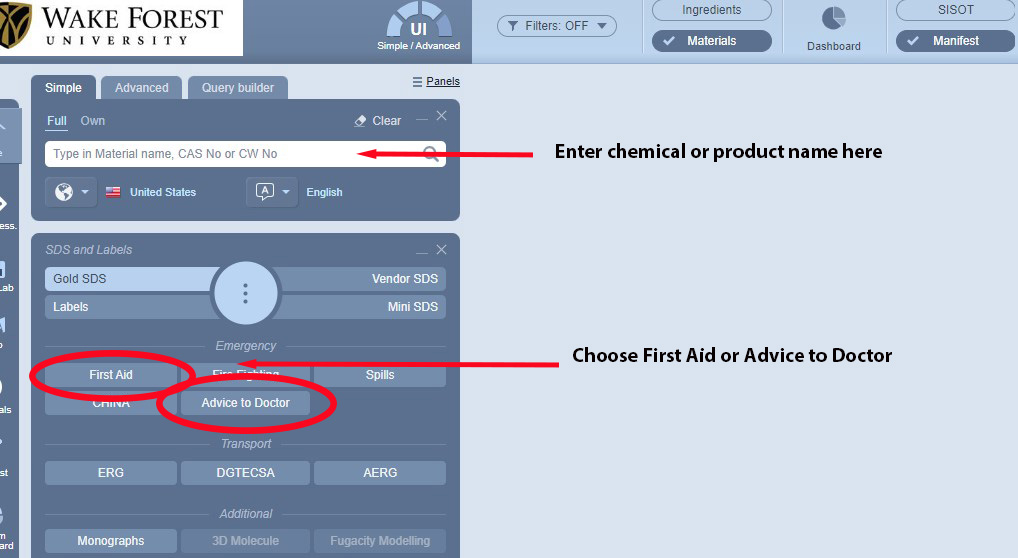
For all chemical exposures, use the Chemwatch First Aid database for appropriate actions and advice to treating physician.
The major risk to laser users is damage to the eye from exposure to a laser beam. The level of damage depends on the wavelength and power of the beam, as well as factors of beam divergence and diameter and the exposure duration.
Seek immediate medical attention if your eyes are exposed to the beam, or if thermal skin damage occurs due to beam exposure.
Treat external or skin contamination by washing with mild soap and copious amounts of lukewarm water (cold water will shrink pores and seal material, hot water will open pores to contaminate more skin). Be mindful of the chemical composition of the contaminant as well; this could pose more of a health issue than the radiation.
- Avoid organic solvents or abrasive soaps that make the skin more permeable to the radioactive material.
- Wash for 2-3 minutes.
- For contaminated hands, give special attention to areas between the fingers and around the fingernails.
- Repeat no more than 3 or 4 times if contamination persists.
- If this procedure fails, repeat washing using a soft hand brush.
When contaminated glassware/sharp instruments lacerate the skin, immediately rinse the wounded area thoroughly under a stream of lukewarm water.
Immediately notify Radiation Safety following ingestion or swallowing of radioactive material.
First Aid Kits
First aid kits are intended to allow persons to treat themselves and/or their co-workers for minor medical incidents and are not intended to replace professional Emergency Medical Services (EMS).
More information as to the contents and use of First Aid Kits may be found here.
Any injury at work should be reported to a supervisor immediately. Supervisors must complete the First Report of Incident form as soon as possible. Information on the workers’ compensation process and contact information for approved clinics can be found on HR’s website.