
Laboratory Ergonomics
Laboratory Ergonomics
Ergonomics is the study of how to arrange and design devices, machines, or workspace so that people and things interact safely and efficiently. Ergonomics is also called human factors analysis or human factors engineering. Occupational Safety and Health Administrations (OSHA) Federal and State Programs describes ergonomics as essentially “the science of fitting the job to the worker”.
Ergonomics of Pipetting
Proper Pipetting Posture
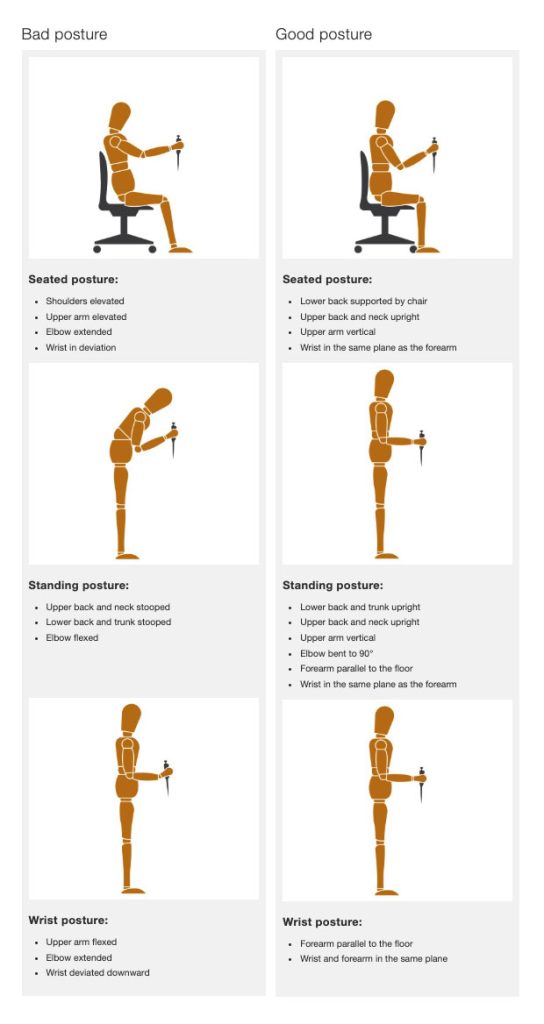
8 Steps to Improve Pipetting Ergonomics

 | Take micro-breaks of 3–5 minutes, for every 12–30 minutes of pipetting |
 | Adjust the workstation so the work can be done with arms close to the body |
 | Use shorter pipettes |
 | Use pipettes that fit comfortably in the user’s hand |
 | Keep samples and instruments within easy reach |
 | Use low profile waste receptacles for used tips |
 | Use anti-fatigue matting when it’s necessary to stand for long periods of time |
 | Use an adjustable stool or chair when sitting |
How to Prevent Repetitive Stress Injuries (RSI) while Pipetting

If you already experience pain from pipetting, or want to make sure that you stay pain free, you should check if your pipettes have been designed with ergonomics in mind. There are several aspects that can influence how much force is required while pipetting, and how often a movement needs to be repeated.
Handle and finger hook
The strain of lifting a pipette and keeping it in an upright position cannot be avoided without switching to benchtop instruments or automated platforms. However, pipettes with a lightweight, well-balanced design are easier to hold. Finger hooks, for example, ensure that some of the pipette’s weight rests on the index finger, and that the hand and fingers can loosen their grip. Moreover, pipettes with handles that can be rotated help to keep the wrist in a neutral position, allowing each user to choose the ideal position for them.
Plunger force
Pipettes only aspirate and dispense liquids when a plunger is moved up and down. When using manual pipettes, the plunger needs to be depressed and released with the help of the thumb. To keep the risk for problems such as thumb tenosynovitis as low as possible, you should select pipettes with a minimal plunger force and stroke distance. Using electronic pipettes is an alternative solution that further minimizes the strain placed on the thumb, as liquid displacement is controlled by a microprocessor.
Tip attachment and ejection forces
Pipette tips are made from polypropylene, which has a memory effect and wants to move back to its original shape. This is why universal tips – designed to fit on cone shaped fittings from multiple manufacturers – eventually loosen, leak or fall off. To avoid these issues, users working with universal tips must hammer their pipettes into the tips to ensure that they are secure for the duration of the pipetting step. This not only leads to high attachment forces, but also increases the ejection force needed to dispose of the tips. Pipettes designed to work with proprietary tips that snap onto the tip fittings feature significantly lower attachment and ejection forces, reducing hand and thumb strain.
Volume change mechanism
Traditional manual pipettes use a single rotating dial or plunger to set the volumes. This approach makes frequent adjustment of volumes tedious for the wrist and fingers, especially when switching from lower to higher volumes. However, there are pipettes with alternative volume change mechanisms, for example those featuring several dials similar to combination locks. These mechanisms can reduce the number of rotational movements and minimize the risk of RSIs.
Efficiency
Performing the same movements over and over again always increases the risk of developing or aggravating an RSI, so you should look for pipettes designed to increase your efficiency. Using multichannel, adjustable tip spacing and electronic pipettes can help.
- Multichannel vs. single channel pipettes: Multichannel pipettes can streamline tasks like transferring reagents from a reservoir to a microwell plate. For example, instead of performing 96 transfers from the reservoir to the 96 well plate with a single channel pipette, an 8 channel pipette will reduce the number of transfers to just 12.
- Adjustable tip spacing vs. single channel pipettes: If all your multichannel pipettes have fixed tip spacing, you need to use a single channel pipette when transferring reagents or samples between different labware formats. Adjustable tip spacing pipettes are the solution to this, as they can transfer several samples between labware formats in parallel, such as between tubes and 384 well plates.
- Electronic vs. manual pipettes: In addition to relieving the thumb force required for depressing and releasing the plunger, electronic pipettes can help you reduce the time spent pipetting. For example, if you need to fill all the wells of a 96 well plate with a specific amount of reagent, you need to go back and forth between the reservoir and the microplate 96 times with a manual single channel pipette. As electronic pipettes offer a repeat dispense mode, you can reduce the number of pipetting steps by aspirating a larger amount of reagent from the reservoir, then aliquoting it into several wells of the 96 well plate.